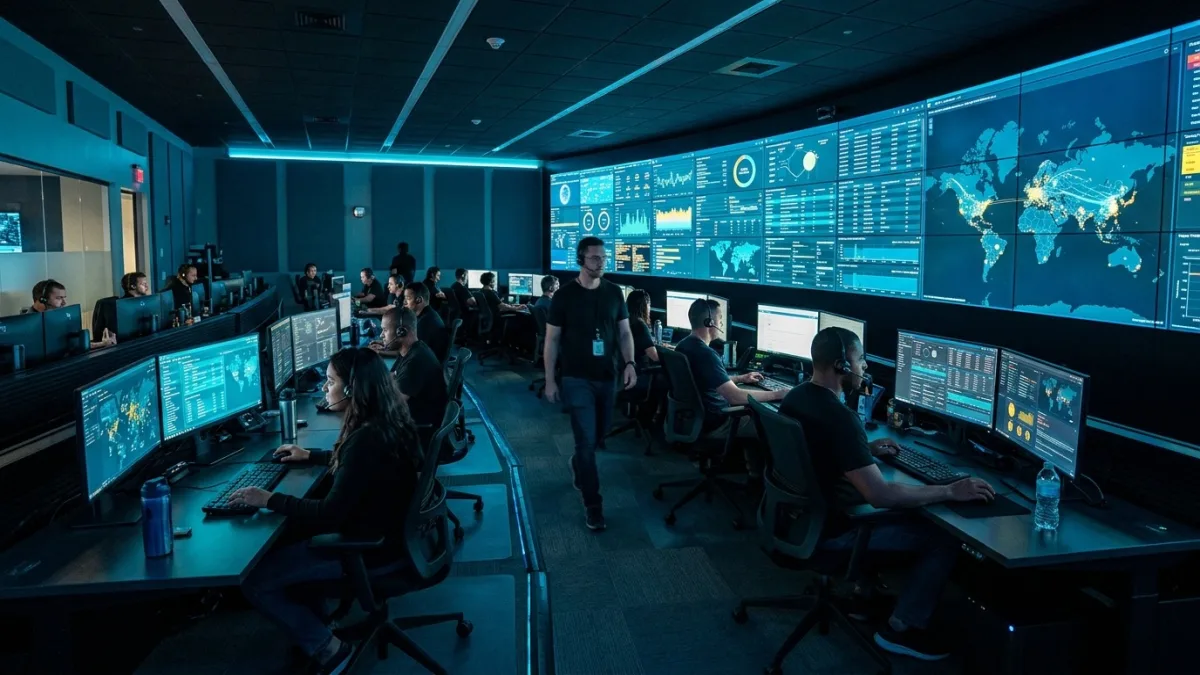
A security operations center (SOC) is the team, process and tooling that monitors your environment around the clock to detect and respond to cyberattacks. SOC as a service (SOCaaS) rents that capability to you on subscription, so a Canadian SMB gets 24/7 monitoring, SIEM correlation, threat hunting and tiered analyst response without hiring eight analysts or buying a platform. Expect CA$1,500–$6,000 per month for monitoring tiers and CA$6,000–$12,000 per month when active managed detection and response is included — a fraction of the CA$1.2M–$2M per year a true in-house 24/7 SOC costs.
What Is a Security Operations Center?
A security operations center is the function inside an organization responsible for continuously watching for, detecting, investigating and responding to cyber threats. It is best understood as three things working together: people (security analysts and threat hunters), process (the playbooks, escalation paths and service levels that govern how alerts are handled) and technology (the SIEM, EDR, network sensors and automation that collect and correlate the data). Remove any one of the three and the SOC stops working — a brilliant analyst with no tooling is blind, and a six-figure platform with no analyst is a smoke detector with the battery removed.
The defining characteristic of a real SOC is that it runs continuously. Attackers do not keep business hours. The Canadian Centre for Cyber Security (CCCS) and incident responders consistently report that a large share of ransomware deployment happens overnight, on weekends and over long holiday weekends — precisely when an SMB's IT contact is asleep and nobody is watching the alert queue. A control that only works from nine to five is, for the windows that matter most, no control at all. That is why "24/7" is not a marketing flourish in SOC language; it is the entire point.
For a Canadian small or medium-sized business, building this in-house is rarely realistic. Covering three shifts a day, seven days a week, with enough relief for vacation, sickness and training, takes a minimum of eight to ten analysts before you have hired a single manager or bought a single tool. That is why the market moved to a service model. SOC as a service — sometimes written SOCaaS — lets a provider build the team and the platform once, then deliver it to dozens or hundreds of clients, spreading the fixed cost so thin that a 40-person accounting firm in Ottawa or a 90-person manufacturer in Mississauga can afford genuine round-the-clock monitoring for a few thousand dollars a month.
This page explains exactly what a modern SOC does, how SOCaaS pricing works in Canada, how the in-house versus outsourced math actually breaks down, where SOCaaS overlaps with managed detection and response (MDR), and what to demand in a contract before you sign. It is distinct from our broader managed security services guide: this page is specifically about the monitoring-and-response engine — the SOC — that sits at the centre of that program.
The Six Core Functions a SOC Performs
A capable SOC — whether in-house or delivered as a service — does six distinct jobs. When you evaluate a SOCaaS provider, you are really asking how well they perform each of these, and which ones are included in your tier versus billed as extras.
1. Continuous monitoring and log collection. The SOC ingests telemetry from across your environment — endpoints, servers, firewalls, the Microsoft 365 or Google Workspace tenant, cloud workloads in Azure or AWS, identity providers, VPN concentrators and email gateways — into a central platform. Without comprehensive collection, the SOC has blind spots, and attackers live in blind spots.
2. Detection and correlation. The SIEM and detection engine apply rules, behavioural analytics and threat intelligence to that flood of data, surfacing the handful of events that matter out of millions of benign ones. Good detection correlates across sources: a single failed login is noise, but a failed login from a foreign IP followed by a successful login and a mailbox forwarding-rule change is an account takeover in progress.
3. Alert triage. Tier 1 analysts validate each alert: is it a true positive, a false positive, or a benign-but-unusual event? This is the unglamorous, high-volume work that determines whether a SOC is useful or just an expensive noise machine. The goal is to stop real threats reaching your inbox while sparing you from thousands of meaningless pings.
4. Incident investigation. When an alert is confirmed, Tier 2 analysts pull the related logs, reconstruct the timeline, and scope the blast radius — which accounts, which devices, which data. This investigation determines whether you are dealing with one compromised laptop or an active intrusion spreading toward your file server.
5. Response and containment. Depending on your tier, the SOC either advises you on the steps to take or directly executes containment — isolating an endpoint, disabling an account, blocking an IP, killing a malicious process. The difference between "monitoring" and "managed detection and response" lives mostly in this function. Containment in minutes versus hours is frequently the difference between an incident and a catastrophe.
6. Threat hunting and detection engineering. The most mature SOCs do not wait for alerts. Tier 3 analysts and threat hunters proactively search for adversary activity that produced no alert — abnormal PowerShell, unusual lateral movement, dormant persistence — and feed what they learn back into new detections. This is the function that separates a premium SOC from a glorified alert relay, and it is the first thing budget providers quietly drop.
SOC, SIEM and EDR — How the Pieces Fit Together
These three terms are constantly confused, and vendors exploit the confusion. Getting them straight is the foundation for understanding what you are actually buying.
A SIEM (security information and event management) is a software platform. It collects logs from many sources, normalises them into a common format, correlates them with rules and analytics, raises alerts, and retains the data for searching and compliance. The SIEM is the SOC's central nervous system, but it is just software — it does not decide anything or take action on its own. Our SIEM explained guide covers the platform side in depth.
An EDR (endpoint detection and response) is also software, but focused specifically on endpoints — laptops, desktops and servers. It records detailed process and behavioural data on each device and can take local action such as isolating a machine or killing a process. EDR is one of the richest sources of telemetry that feeds the SIEM, and it is the engine behind most MDR offerings. Our endpoint protection services guide explains where EDR fits.
A SOC is not software at all — it is the operational capability that runs on top of the SIEM and EDR. It is the analysts watching the SIEM's alerts, the playbooks governing their response, the threat hunters tuning the detections, and the service levels that promise someone is always awake. You can buy a SIEM and never have a SOC; you cannot have a SOC without something like a SIEM to watch.
The single most common and most dangerous mistake Canadian SMBs make is buying a SIEM (or worse, turning on the native logging in Microsoft 365 E5) and assuming they now have a SOC. They have bought the fire alarm. Nobody is listening for it. Three months later the alerts are unread, the storage is filling up, and the false-positive fatigue has trained the IT contact to ignore the platform entirely. SOCaaS exists precisely to provide the missing human and process layer.
| Term | What it is | What it covers | Acts on its own? |
|---|---|---|---|
| SIEM | Log/event platform (software) | Whole environment, all sources | No — alerts only |
| EDR | Endpoint sensor (software) | Laptops, desktops, servers | Partly — local containment |
| SOC | People + process + tooling | Detection, triage, response, hunting | Yes — humans decide and act |
| SOCaaS | A SOC rented on subscription | All of the above, outsourced | Yes — provider's analysts |
The SOC Analyst Tiers — Who Does What
SOCs organise their analysts into tiers, and understanding the model tells you a great deal about what you are paying for. The tiered structure exists to keep expensive senior time focused on genuine threats while routine work is handled efficiently.
Tier 1 — Triage analysts. The front line. They monitor the alert queue 24/7, perform initial validation, close false positives, and escalate anything that looks real. A good Tier 1 function dramatically reduces the volume that ever reaches a human decision-maker on your side. The risk with budget providers is that Tier 1 is the only tier — alerts get forwarded to you with no real investigation, and you become the SOC.
Tier 2 — Incident responders. When Tier 1 escalates, Tier 2 investigates. They pull related logs across sources, reconstruct the attack timeline, scope which assets and accounts are affected, and decide on containment actions. This is where genuine security expertise starts to matter — and where the quality gap between providers is widest.
Tier 3 — Threat hunters and detection engineers. The most senior analysts. They proactively hunt for threats that generated no alert, develop and tune new detection content, lead response on serious incidents, and reverse-engineer novel malware when needed. A SOC with a real Tier 3 capability finds intrusions that signature-based tools miss entirely. Ask any provider directly: do you have dedicated threat hunters, and how many hunting hours per month does my tier include?
SOC manager and engineering. Behind the analysts sit a SOC manager who owns service levels and quality, and a detection-engineering function that maintains the SIEM rules, integrations and automation. In a SOCaaS model these roles are shared across all clients, which is exactly why the economics work in your favour.
When you read a SOCaaS proposal, map every promised activity to a tier. "24/7 monitoring" is Tier 1. "Investigation and response" is Tier 2. "Proactive threat hunting" is Tier 3. If a low monthly price only buys Tier 1, you are buying an alert forwarder, not a security operations center — and you should price that accordingly.
In-House SOC vs SOC as a Service — The Real Cost Math
The decision that drives most organizations to SOCaaS is simple arithmetic. Building a genuine 24/7 in-house SOC is one of the most expensive commitments in IT, and the cost is overwhelmingly people, not tools.
To cover three shifts a day, seven days a week, with relief for vacation, illness, training and turnover, you need a minimum of eight to ten analysts — and realistically a manager and a detection engineer on top. In the 2026 Canadian market, a Tier 1 analyst costs roughly CA$70,000–$95,000, a Tier 2 analyst CA$95,000–$130,000, and a Tier 3 hunter or lead CA$130,000–$180,000, all before benefits, payroll taxes, recruiting and the productivity loss from the chronic turnover that plagues SOC roles. Fully loaded, a bare-minimum 24/7 team lands at CA$1.2M–$2M per year in salary alone.
Then come the tools: a commercial SIEM licensed by data volume (CA$40,000–$200,000+ per year for an SMB-to-midmarket footprint), EDR licensing, threat-intelligence feeds, a SOAR automation platform, and the infrastructure to run it all. Add the 12-to-18-month build time to recruit, train and operationalise the team, and the all-in first-year cost of a real in-house SOC for a mid-market Canadian organization comfortably exceeds CA$2M. For a 60-person business doing CA$15M in revenue, that is not a security budget — it is a non-starter.
SOCaaS collapses that number because the provider amortises the team and the platform across its whole client base. You are effectively buying a slice of a shared SOC. The table below lays the two models side by side for a representative 75-person Canadian business.
| Cost factor | In-house 24/7 SOC | SOC as a service |
|---|---|---|
| Analyst staffing (8–10 FTE) | $1,200,000–$2,000,000/yr | Included in subscription |
| SIEM + tooling licences | $60,000–$250,000/yr | Included in subscription |
| Build / ramp time | 12–18 months | 2–6 weeks onboarding |
| 24/7 coverage | Only if fully staffed | Day one |
| Threat-hunting depth | Limited by team size | Shared senior talent pool |
| Typical first-year total | $1.5M–$2.5M | $30,000–$120,000 |
The crossover point where building in-house starts to make sense is generally above 500–1,000 employees, or in organizations with regulatory mandates (certain financial institutions under OSFI expectations, large healthcare networks) that require direct control of the SOC. For essentially every Canadian SMB and most of the mid-market, SOCaaS is not just cheaper — it delivers better coverage, because no eight-person internal team can match the breadth of threats a shared SOC sees across hundreds of clients. For a closer look at the build-versus-buy decision in IT generally, see our managed IT versus in-house cost analysis.
SOCaaS Pricing in Canada — What to Budget in 2026
SOCaaS pricing is driven by a few variables: the volume of log data ingested (often measured in events per second or gigabytes per day), the number of endpoints and users, the breadth of sources monitored, the depth of response (advisory versus hands-on containment), and the service levels you require. Providers package these into tiers. The table below reflects representative 2026 Canadian market pricing for SMB and lower-mid-market organizations.
| Tier | What you get | CA$/month |
|---|---|---|
| Essential monitoring | 24/7 SIEM monitoring, Tier 1 triage, alert-and-advise, monthly reporting (≤50 endpoints) | $1,500–$3,500 |
| Managed detection (mid) | Above plus Tier 2 investigation, EDR-based containment, cloud + identity monitoring (50–150 endpoints) | $3,500–$6,500 |
| Full MDR + hunting | Above plus active 24/7 containment, Tier 3 threat hunting, IR retainer, named analyst (150–400 endpoints) | $6,500–$12,000 |
| Per-endpoint add-on | Incremental EDR + monitoring beyond bundle | $8–$22/endpoint |
| One-time onboarding | Log-source integration, tuning, baseline (varies by complexity) | $3,000–$15,000 |
A few pricing cautions. First, watch the data-volume model: providers that bill purely on ingest can produce nasty surprises when a chatty new log source spikes your gigabytes-per-day. Ask for a cap or a predictable per-endpoint model. Second, "24/7 monitoring" at the bottom of the market frequently means a Tier 1 queue that emails you and stops there — read carefully whether response is advisory or hands-on. Third, onboarding is real work; a provider quoting zero onboarding is either subsidising it to win the deal or skipping the tuning that makes the service useful. For the wider security spend picture, our 2026 Canadian managed IT cost guide sets SOCaaS in context against the rest of an IT budget.
SOCaaS vs MDR vs MSSP — Untangling the Overlap
Three acronyms dominate the outsourced-security market and they overlap enough to confuse even experienced buyers. Here is the practical distinction.
MDR (managed detection and response) is usually the most narrowly scoped of the three and the most response-focused. Classic MDR is centred on an EDR platform deployed across your endpoints, with the provider's analysts watching that EDR's telemetry and rapidly containing threats — isolating a machine, killing a process — often with a strong service-level promise on response time. MDR's strength is speed and depth on the endpoint; its limitation is that it can be blind to attacks that never touch a monitored endpoint, such as a cloud-identity compromise or an email-only business email compromise.
SOCaaS is broader. It ingests logs from the whole environment — endpoints, network, firewall, cloud, identity, email, SaaS — into a SIEM and provides the full security-operations capability around it: monitoring, correlation across sources, triage, investigation, response and hunting. Where MDR sees the endpoint, SOCaaS sees the enterprise. In practice many providers bundle MDR-style endpoint response inside a SOCaaS offering, which is why the labels blur.
MSSP (managed security service provider) is the oldest and broadest term. An MSSP manages security devices and tools on your behalf — running your firewall, your VPN, your email gateway, your patching — and increasingly offers SOC and MDR services as part of the portfolio. The historical knock on traditional MSSPs was that they managed the tools but did relatively little active detection and response; modern MSSPs and SOCaaS providers have converged considerably.
The practical takeaway for a Canadian SMB: do not buy on the acronym, buy on the capability. Map exactly which of the six SOC functions the provider performs, which sources they monitor, and whether they will actively contain a threat or merely alert you. A "SOCaaS" that only watches endpoints is really MDR; an "MDR" that ingests your cloud and identity logs is really SOCaaS. Our managed security services guide walks through how these pieces assemble into a complete program, and incident response planning covers what the SOC hands off to when an incident is confirmed.
Threat Hunting — The Difference Between Watching and Defending
Alert-driven monitoring is reactive by definition: something has to trip a detection before anyone looks. But the most damaging intrusions are precisely the ones engineered to trip nothing. An attacker who steals valid credentials and logs in like a legitimate user, who uses built-in Windows tools rather than malware (a technique called "living off the land"), and who moves slowly and quietly, can sit inside a network for weeks generating no alert at all. The CCCS and global incident responders repeatedly find that dwell time — the gap between initial compromise and detection — stretches into weeks or months when nobody is hunting.
Threat hunting is the proactive discipline that closes that gap. Rather than waiting for an alert, a hunter forms a hypothesis — "if an attacker had valid VPN credentials, what would their lateral movement look like in our logs?" — and goes looking for the evidence. Hunting leans on frameworks such as MITRE ATT&CK to systematically cover adversary techniques, and on behavioural analytics to surface the abnormal-but-not-yet-alerting. When a hunt finds something, the discovery feeds back into a new detection rule, so the SOC gets sharper over time.
This is the capability budget SOCaaS quietly omits. A CA$1,500-a-month tier almost never includes real hunting hours — it cannot, because hunting consumes the most expensive analysts. When you compare proposals, ask precisely: how many threat-hunting hours per month are included, who performs them, and will you receive written hunt reports? A provider that cannot answer is selling monitoring, not defence. For organizations that want hands-on technical execution paired with the strategy, IT Cares can deploy and operate the SOC tooling on-site for Canadian businesses, bridging the gap between an outsourced analyst queue and the people who actually configure and maintain your endpoints and network.
How SOCaaS Onboarding Works — Step by Step
A SOCaaS engagement does not produce value the moment the contract is signed. It produces value once log sources are connected, detections are tuned to your environment, and the noise floor has been beaten down. A competent onboarding follows a predictable sequence.
- Scoping and asset inventory (Week 1). The provider maps your environment — endpoints, servers, cloud tenants, identity providers, firewalls, critical SaaS — and agrees what will and will not be monitored. Gaps in the inventory become gaps in coverage, so this step decides how blind the SOC will be.
- Log-source integration (Weeks 1–3). Connectors and agents are deployed to pipe telemetry into the SIEM: EDR agents on every endpoint, API connections to Microsoft 365 or Google Workspace, syslog from firewalls and network gear, cloud audit logs from Azure or AWS, and identity logs from your directory. This is the heaviest technical lift.
- Baseline and tuning (Weeks 2–4). The SOC observes normal behaviour to establish a baseline, then tunes detection rules to suppress the false positives that always flood in on day one. Skipping this step is how SOCs become noise machines that everyone learns to ignore.
- Playbook and escalation agreement (Weeks 3–4). You and the provider agree the response playbooks: which actions the SOC may take autonomously (isolate an endpoint, disable an account), which require your sign-off, who they call at 3 a.m., and the escalation chain. Putting this in writing before an incident is the difference between coordinated response and chaos.
- Service-level activation (Week 4–6). The SLAs go live — mean time to detect, time to acknowledge, time to contain — with the agreed credits for misses. From here the SOC is in steady-state operation, watching around the clock.
- Continuous tuning and reporting (ongoing). Monthly reporting on incidents, trends and posture; quarterly reviews of detections and threat-hunt findings; ongoing adjustment as your environment and the threat landscape change. A SOC that never re-tunes after onboarding decays.
Total time from contract to fully tuned steady state is typically four to six weeks for an SMB and somewhat longer for complex multi-site or heavy-cloud environments. Beware any provider promising "instant" coverage — the agents may install instantly, but the detections that make coverage useful take weeks to tune to your reality.
SOCaaS and Canadian Compliance — PIPEDA, Law 25 and Insurance
A SOC is not just a security control — it is increasingly a compliance and insurance instrument. Canadian regulators and insurers now expect organizations to detect incidents and respond to them on a defined timeline, and a SOC is the machinery that makes that possible.
PIPEDA. The federal Personal Information Protection and Electronic Documents Act requires organizations to implement security safeguards appropriate to the sensitivity of the personal information they hold, and to report breaches that pose a "real risk of significant harm" to the Office of the Privacy Commissioner and affected individuals, while keeping records of all breaches for at least 24 months. A SOC produces the continuous monitoring, the log retention, and — critically — the forensic timeline needed to assess whether a breach crossed the real-risk threshold and to defend that assessment afterward.
Quebec Law 25. Quebec's modernized privacy law is stricter: breaches involving personal information must be reported to the Commission d'accès à l'information (CAI) and affected individuals where there is a risk of serious injury, and the practical expectation is rapid notification — organizations scramble when they cannot reconstruct what happened. A SOC's investigation timeline and retained logs are exactly what let you answer the CAI's questions inside the window, rather than guessing. Penalties under Law 25 reach into the millions, which reframes 24/7 monitoring from a cost into cheap insurance. Our Law 25 compliance guide covers the obligations in full.
Cyber insurance. Canadian cyber-liability underwriters increasingly require — or heavily discount for — 24/7 monitoring, EDR on all endpoints, and a documented incident-response capability. A SOCaaS subscription checks several of those boxes at once and produces the evidence package brokers ask for at renewal. In a claim, the SOC's logs and timeline are also what substantiate the claim and rebut an insurer's argument that you failed to maintain the controls you attested to.
In short, SOCaaS converts "we take security seriously" from an assertion into documented, time-stamped evidence — which is precisely what regulators, insurers and, increasingly, your own enterprise customers' vendor-risk questionnaires demand.
10 Questions to Ask a SOCaaS Provider Before You Sign
The SOCaaS market ranges from genuine 24/7 operations with senior hunters to thinly staffed alert-forwarders with a polished dashboard. These questions surface the difference before you commit.
- Is monitoring genuinely 24/7/365 with live analysts overnight? Or does "24/7" mean automated alerting after hours with humans only during business hours? Ask where the analysts are physically located and how overnight shifts are staffed.
- Do you actively contain threats, or only alert and advise? Get the exact line between what the SOC will do autonomously and what requires your approval, in writing.
- What are your MTTD and MTTR commitments? Demand mean-time-to-detect and mean-time-to-respond figures as contractual SLAs with credits for misses — not aspirational marketing numbers.
- Which log sources do you monitor for my price? Endpoints only (that's MDR), or also cloud, identity, email, network and SaaS? Blind spots are where breaches live.
- How many threat-hunting hours per month are included, and who performs them? If the answer is vague or "as needed," there is no real hunting.
- What SIEM and EDR do you use, and do I keep my data if I leave? Confirm you are not locked into a platform you cannot export from, and that log retention meets PIPEDA's 24-month record expectation.
- Where is my data stored and processed? For Canadian privacy and some sector rules, data residency in Canada may matter — confirm the SIEM and log storage region.
- How do you handle the handoff to incident response? Is there an IR retainer? Who leads a serious breach — the SOC, your team, or a third party — and how is that coordinated?
- How is onboarding scoped and priced? A provider that skips tuning will drown you in false positives; one that charges nothing may be cutting the work that makes the service useful.
- Can I see a sample monthly report and a redacted incident write-up? The quality of the reporting tells you whether real analysts are doing real work, or whether you are buying a dashboard.
Common Mistakes Canadian SMBs Make With SOCaaS
Even organizations that correctly decide to buy SOCaaS often undercut the value with a handful of predictable errors.
Buying a SIEM and calling it a SOC. The platform is necessary but not sufficient. Without analysts and process, a SIEM is unread alerts and rising storage bills. If you cannot staff 24/7 monitoring yourself, buy the operation, not just the tool.
Choosing the cheapest tier and assuming full coverage. Bottom-of-market SOCaaS is usually Tier 1 alert-forwarding with no investigation, no containment and no hunting. You become the SOC, at 3 a.m., with none of the expertise. Price the tier against what it actually does.
Monitoring endpoints only. Modern attacks pivot through cloud identity and email — business email compromise often never touches a monitored endpoint at all. An endpoint-only deployment is blind to a whole class of the most common SMB incidents. Insist on cloud, identity and email coverage.
Skipping the response playbook. If the SOC detects an account takeover at midnight and your contract never specified whether they may disable the account or must wait for your call-back, the attacker wins the time you spend deciding. Agree the autonomous-action boundary before go-live.
Treating SOCaaS as the entire security program. Monitoring detects and responds; it does not prevent. Without MFA, patching, backups, email security and user training underneath, the SOC spends its time responding to incidents that basic hygiene would have stopped. SOCaaS sits on top of the fundamentals covered in our small business cybersecurity hub — it does not replace them.
Ignoring tuning after onboarding. Environments drift, new SaaS gets adopted, and detections decay. A SOC nobody re-tunes slowly fills with false positives until alerts are ignored. Insist on quarterly tuning reviews as part of the service.
Case Study: Anonymized Logistics Firm, Mississauga (2025)
The following is a composite case study based on a typical engagement profile for a Canadian mid-market business. Identifying details have been changed.
The client: An 85-person freight and logistics company in Mississauga, running a hybrid environment — Microsoft 365, an on-premises transportation-management system, a warehouse network, and remote dispatchers connecting over VPN. Annual revenue approximately CA$22M. A two-person internal IT team handled day-to-day support but had no security monitoring; logs were collected nowhere and read by no one. A major retail customer's vendor-risk questionnaire demanded evidence of 24/7 monitoring, which the firm could not provide.
The engagement: A mid-tier SOCaaS subscription at CA$5,400 per month covering 24/7 SIEM monitoring, Tier 2 investigation, EDR-based containment on all 110 endpoints, and cloud and identity monitoring of the Microsoft 365 tenant, plus a CA$9,000 onboarding to integrate the log sources and tune detections. Full MDR with active overnight containment was included after a 30-day baseline.
What happened: Six weeks after go-live, at 2:40 a.m. on a Saturday, the SOC's correlation engine flagged an impossible-travel login — a dispatcher's account authenticating from Toronto and, eleven minutes later, from an IP geolocated in Eastern Europe — immediately followed by the creation of an inbox forwarding rule and an attempt to enrol a new MFA device. Tier 1 escalated within four minutes; Tier 2 confirmed an account takeover and, under the pre-agreed playbook, disabled the account, revoked active sessions, and removed the forwarding rule before any data left the tenant. The dispatcher's reused password had been exposed in an unrelated breach and replayed by an automated credential-stuffing run.
The outcome: Total time from first malicious login to containment was under 30 minutes, overnight, with no internal staff awake. The firm reset the affected credentials, enforced MFA on all accounts, and passed the retail customer's vendor-risk questionnaire on the strength of the SOC's incident timeline and monitoring evidence — winning a contract renewal worth far more than the annual SOCaaS spend. The most telling detail: before the SOC existed, this same takeover would have run undetected until Monday morning, by which point mailbox rules would have silently exfiltrated weeks of freight invoices and customer banking details, almost certainly triggering a PIPEDA and Law 25 reporting obligation.
The lesson is not that the attack was sophisticated — it was routine credential stuffing. The lesson is that detection and response in minutes, overnight, by people who were awake, turned a potential breach into a non-event.
Is SOCaaS Right for Your Business? A Quick Readiness Checklist
Work through the checklist below. If you tick three or more, your organization has reached the point where outsourced 24/7 security operations is no longer optional but a defensible business decision.
- You hold sensitive personal, financial or health information subject to PIPEDA or Quebec Law 25.
- Nobody in your organization is monitoring security alerts overnight, on weekends, or over holidays.
- A customer, insurer or regulator has asked you to demonstrate 24/7 monitoring or detection-and-response capability.
- You have a SIEM, Microsoft 365 E5 logging or EDR that nobody is actively watching or tuning.
- You are too small to justify eight-plus security analysts but too exposed to run blind.
- You supply goods or services to larger organizations that audit your security as a condition of doing business.
- You have suffered a near-miss, a phishing success, or a ransomware scare and realised you would not have seen it coming.
- Your cyber-insurance renewal now requires monitoring, EDR and a documented incident-response capability.
If you ticked fewer than three, you may be better served by first shoring up the fundamentals — MFA, patching, backups, email security and user awareness — before layering monitoring on top. Our small business cybersecurity hub and managed security services guide lay out that foundation, and a SOC becomes far more valuable once it sits on a hardened base rather than firefighting preventable incidents.
Related Guides
- Managed Security Services Canada →
- What Is a SIEM? Plain-Language Guide →
- Endpoint Protection & EDR Services →
- Cybersecurity Incident Response Planning →
- Small Business Cybersecurity Hub →
- Quebec Law 25 Compliance Guide →
- Cybersecurity Services Canada — Provider Guide →
Frequently Asked Questions
What is SOC as a service (SOCaaS)?
SOC as a service is an outsourced security operations center delivered on subscription. A third-party provider supplies the analysts, the SIEM and detection tooling, and the 24/7 monitoring needed to detect and respond to cyber threats — so a business gets enterprise-grade security operations without building its own team or buying its own platform. For most Canadian SMBs it costs CA$1,500–$12,000 per month depending on data volume, endpoint count and response scope.
How much does SOC as a service cost in Canada?
For a typical 25-to-100-person Canadian business, SOCaaS runs CA$1,500–$6,000 per month for monitoring-and-alert tiers and CA$6,000–$12,000 per month when full managed detection and response with active containment and threat hunting is included. Pricing is driven mainly by log volume (events per second or gigabytes per day), the number of endpoints and users, and whether response is advisory or hands-on. Expect a one-time onboarding fee of CA$3,000–$15,000 to integrate and tune log sources.
What is the difference between a SOC and a SIEM?
A SIEM is a software platform that collects, correlates and stores security logs and generates alerts. A SOC is the team, process and tooling that operates around that platform — the human analysts who triage the alerts, hunt for threats the SIEM misses, and drive incident response. A SIEM without a SOC is a fire alarm with nobody listening for it; the most common SMB mistake is buying the platform and assuming it is the capability.
Is SOCaaS the same as MDR?
They overlap heavily but are not identical. MDR (managed detection and response) is usually focused on endpoints and centred on a specific EDR platform, with rapid containment as the headline. SOCaaS is broader: it ingests logs from the whole environment — endpoints, network, cloud, identity and email — into a SIEM and provides full security operations including correlation across sources and threat hunting. Many providers bundle MDR inside a SOCaaS offering, so the labels blur in practice. Buy on capability, not acronym.
Should a small business build an in-house SOC or buy SOCaaS?
For almost every Canadian business under about 500 employees, SOCaaS is the better economic choice. A genuine 24/7 in-house SOC needs at least eight to ten analysts to cover three shifts plus relief, which runs CA$1.2M–$2M per year in salary alone before tooling and 12–18 months of build time. SOCaaS delivers equivalent or better coverage for CA$30,000–$120,000 per year because the provider spreads analysts and platform cost across many clients. Building in-house typically only makes sense above 500–1,000 employees or under specific regulatory mandates.
What does a SOC analyst actually do all day?
A Tier 1 analyst monitors the alert queue around the clock, validates whether alerts are real, and closes false positives. A Tier 2 analyst investigates confirmed incidents, pulls related logs, reconstructs the timeline and scopes the blast radius. A Tier 3 analyst or threat hunter proactively searches for adversary activity that produced no alert, tunes detections, and leads response on serious incidents. The tiered model keeps expensive senior time focused on real threats rather than routine noise.
Does SOCaaS help with PIPEDA and Quebec Law 25 compliance?
Yes. SOCaaS produces the continuous log retention, monitoring evidence and documented incident-response capability that PIPEDA's safeguard expectations and Quebec's Law 25 require. When a breach occurs, the SOC's investigation timeline and retained forensic logs support the rapid notification Quebec's CAI expects and the real-risk-of-significant-harm assessment PIPEDA requires — and they substantiate cyber-insurance claims. It converts "we take security seriously" into time-stamped, defensible evidence.
How fast can a SOCaaS provider detect and respond to an attack?
Mature SOCaaS providers commit to service levels measured in minutes: typically 10–15 minutes to acknowledge a critical alert and 30–60 minutes to begin containment for full MDR tiers. Ask any provider for their mean time to detect (MTTD) and mean time to respond (MTTR) figures, confirm they are 24/7 with live analysts overnight, and have the SLA written into the contract with credits for misses — not left as aspirational marketing numbers.
Get your free SOC readiness plan
Tell us about your environment and what keeps you up at night. We send back a clear, no-pressure assessment of whether SOCaaS fits — and what to prioritise first — within one business day. No payment required.