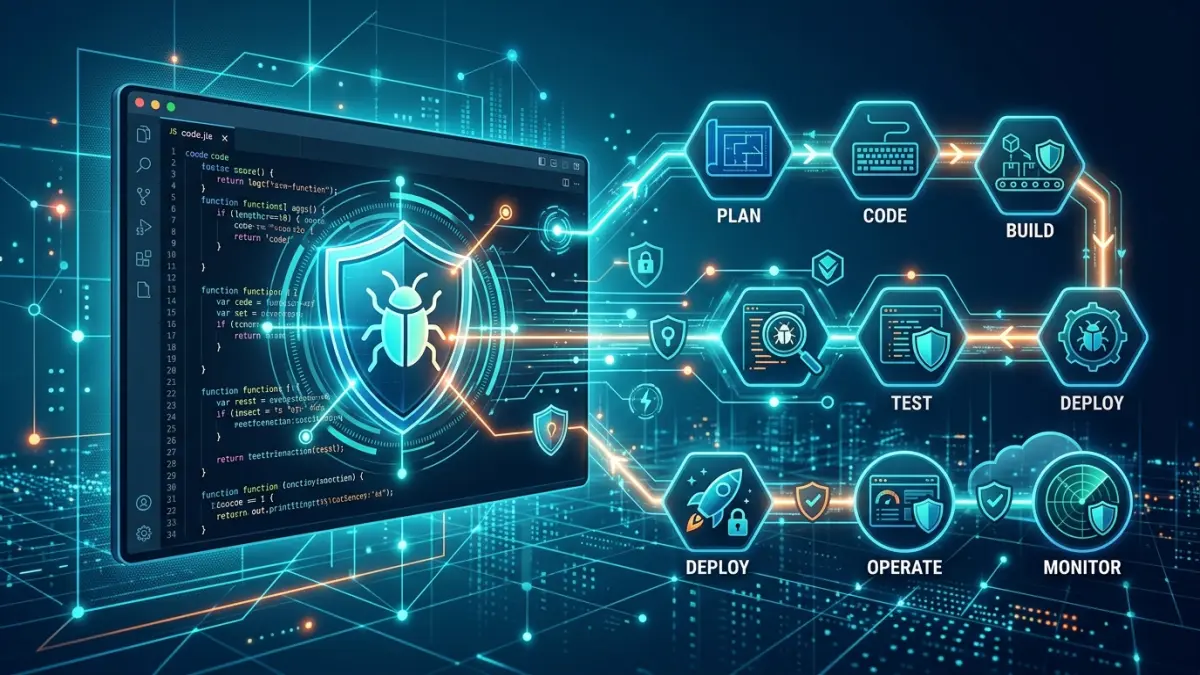
Application security (AppSec) services find and fix the vulnerabilities in software your business builds or operates. A typical engagement combines automated SAST and DAST scanning, manual secure code review, API security testing, software composition analysis of open-source dependencies, and threat modeling — with every finding mapped to the OWASP Top 10 and a prioritized remediation plan. For Canadian SMBs, a focused web application penetration test runs CA$8,000–$18,000, a secure code review CA$6,000–$20,000, and continuous AppSec retainers CA$2,500–$8,000 per month.
What Is Application Security?
Application security — usually shortened to AppSec — is the discipline of finding, fixing, and preventing security flaws in the software your organization builds, customizes, or relies on. It is distinct from network security or endpoint protection, which guard the infrastructure around your software. AppSec is concerned with the code itself: the web application customers log into, the API your mobile app calls, the internal portal your staff use, the open-source libraries quietly running underneath all of it.
For Canadian businesses, application security has become unavoidable for a simple reason: software is now the front door. A retailer's checkout, a clinic's patient portal, a logistics firm's tracking dashboard, a SaaS company's entire product — these are the systems that hold personal information, process payments, and connect to the rest of the business. When attackers want data, they increasingly go after the application layer, because a single exploitable flaw in code can expose every record behind it at once. Verizon's 2024 Data Breach Investigations Report found that exploitation of vulnerabilities as an initial breach action nearly tripled year over year, with web applications a leading vector.
A complete AppSec service answers three questions. Where are the flaws? — through static analysis of your source code (SAST), dynamic testing of the running application (DAST), manual secure code review, API testing, and software composition analysis of your dependencies. Which ones matter? — by triaging every finding against the OWASP Top 10 and rating it by real exploitability and business impact, not just scanner severity. How do we fix them, and how do we stop creating new ones? — through developer-ready remediation guidance and, ideally, integration of security into your software development life cycle so the next release ships with fewer flaws than the last.
Crucially, AppSec is not a one-time scan. Software changes with every deployment, and a clean report on Monday says nothing about the feature you ship on Friday. The organizations that get the most value treat application security as a continuous program — automated testing in the pipeline, periodic deep manual review, and a clear owner accountable for the backlog of findings.
Why Application Security Matters for Canadian Businesses Now
Three shifts have moved application security from a niche concern for software companies to a baseline expectation for almost any Canadian business that operates online.
Everyone ships software now. You no longer need to be a tech company to be a software company. The accounting firm with a client portal, the manufacturer with a customer ordering system, the non-profit collecting donations through a custom web form — all of them build or commission applications that hold personal information. The Communications Security Establishment's National Cyber Threat Assessment repeatedly identifies web-facing applications as a primary route for ransomware and data theft against Canadian organizations, precisely because so many were built without security review.
The dependency problem is enormous. Modern applications are assembled, not written from scratch. Between 70% and 90% of a typical codebase is third-party open-source code pulled in through package managers like npm, PyPI, Maven, or NuGet. That is efficient — and it means a vulnerability in a single popular library can expose thousands of organizations simultaneously. The Log4Shell vulnerability (CVE-2021-44228) in the Apache Log4j logging library in December 2021 is the defining example: a flaw in one ubiquitous component left an enormous swath of Canadian and global software exploitable overnight. Most organizations affected did not even know they were using Log4j until the alerts started. Without software composition analysis, you cannot answer the question every board asked that week: "Are we exposed?"
Regulators and buyers now expect proof. Under PIPEDA and Quebec's Law 25, organizations must implement security safeguards proportionate to the sensitivity of the personal information they handle — and an insecure application that leaks personal data is a direct failure of that obligation. Beyond regulators, Canadian enterprise and government buyers increasingly require evidence of application security testing in their procurement and vendor-risk questionnaires. A current penetration test report and a documented secure SDLC are now table stakes for winning larger contracts. The cost of skipping AppSec is no longer just breach risk; it is lost revenue when a prospect's security team blocks the deal.
The economics strongly favour proactive testing. Industry research has long held that a defect caught in design or development costs a fraction of the same defect caught in production — and that ratio explodes once a flaw is exploited, when you add breach response, regulatory notification, customer churn, and remediation under pressure to the bill. With the average Canadian data breach now costing in the millions, a CA$12,000 application assessment is inexpensive insurance.
The Core Application Security Services
"Application security" is an umbrella over several distinct services. A mature program uses most of them; a first engagement usually starts with two or three. Understanding what each one does — and what it misses — lets you scope an engagement that fits your software and budget rather than paying for tests you don't need.
1. Static application security testing (SAST). Analyzes your source code, bytecode, or compiled binaries without running the application. SAST reads the code the way a security-trained reviewer would, flagging dangerous patterns: SQL queries built by string concatenation, user input flowing into a command shell, hardcoded credentials, weak cryptography. Its strength is coverage and timing — it can scan the entire codebase early in development, before anything is deployed. Its weakness is false positives, which is why SAST output must be triaged by a human rather than handed raw to developers.
2. Dynamic application security testing (DAST). Tests the running application from the outside, the way an attacker would, without access to the source code. DAST sends crafted requests to find authentication bypasses, injection flaws, session-management weaknesses, and server misconfigurations that only appear at runtime. Where SAST finds what could be wrong in the code, DAST confirms what is actually exploitable in the deployed system. The two are complementary, not interchangeable.
3. Secure code review. Manual, expert examination of high-risk code by a security engineer. Automated scanners are pattern matchers; they cannot understand intent, business logic, or whether a given authorization check is actually sufficient. A human reviewer finds the flaws that matter most — broken access control, logic errors in payment or privilege handling, subtle authentication mistakes — that no scanner reliably catches. Secure code review is the highest-value-per-hour AppSec activity for applications handling money or sensitive data.
4. Software composition analysis (SCA). Inventories every open-source and third-party component in your application and checks each against known-vulnerability databases — the CVE list, the GitHub Advisory Database, language-specific advisories. SCA produces a software bill of materials (SBOM) and tells you exactly which dependencies carry known, exploitable flaws and which versions fix them. Because so much of your code is third-party, SCA frequently surfaces the single most urgent item in the entire engagement.
5. API security testing. Focused testing of the APIs behind your mobile apps, single-page front ends, and partner integrations. APIs are now the most attacked surface in modern software and carry their own risk catalogue, the OWASP API Security Top 10. Many API flaws — especially authorization flaws like accessing another customer's records by changing an ID in the request — require understanding business logic and object ownership, which generic web scanners miss entirely.
6. Threat modeling. A structured, design-phase exercise that asks "how could this be attacked?" before a line of code is written or a feature is shipped. Threat modeling maps the data flows, trust boundaries, and assets in an application, then systematically identifies what could go wrong and what controls mitigate each threat. It is the cheapest form of application security because it prevents flaws rather than finding them later.
7. Web application penetration testing. A goal-oriented, manual assessment in which a security professional attempts to compromise the application the way a real attacker would, chaining together vulnerabilities to demonstrate genuine business impact. A penetration test is the form of AppSec that buyers, insurers, and auditors most often ask for by name — and the report is the artifact you hand them as evidence.
SAST vs. DAST vs. SCA vs. Pen Testing — When to Use Each
These acronyms overlap in marketing but differ sharply in what they actually find and when in the development cycle they fit. The table below compares the four most common testing types so you can match the method to your risk and stage.
| Method | What it tests | Best at finding | When in SDLC |
|---|---|---|---|
| SAST | Source code (white-box) | Injection patterns, hardcoded secrets, weak crypto | Coding / every commit |
| DAST | Running app (black-box) | Auth bypass, runtime misconfig, exploitable injection | Staging / pre-release |
| SCA | Open-source dependencies | Known CVEs in libraries, licence risk, SBOM gaps | Build / continuous |
| Pen test | Whole app, manually | Business-logic flaws, chained exploits, real impact | Pre-release / annual |
The practical rule: automated tools (SAST, DAST, SCA) give you breadth and speed; manual work (secure code review, penetration testing) gives you depth and confidence. A program that relies only on scanners drowns in false positives and misses the high-impact business-logic flaws that cause real breaches. A program that relies only on annual manual tests leaves eleven months of unreviewed code. The right answer for most Canadian SMBs is automated testing wired into the pipeline for continuous coverage, plus a deep manual assessment once or twice a year and before any major release.
The OWASP Top 10 — What Actually Gets Exploited
The OWASP Top 10 is the industry-standard list of the most critical web application security risks, published by the Open Worldwide Application Security Project. It is the common language of application security: a credible AppSec report maps every finding to an OWASP category so that leadership, auditors, and insurers can understand the organization's exposure without reading a single line of code. The current edition is led by Broken Access Control, which has become the most prevalent serious flaw in modern web applications.
| Risk category | What it means in practice |
|---|---|
| Broken Access Control | A user can reach data or actions they shouldn't — e.g. viewing another customer's records by changing an ID. |
| Cryptographic Failures | Sensitive data sent or stored without proper encryption, exposing personal information. |
| Injection | Untrusted input alters a query or command — SQL injection, cross-site scripting (XSS), command injection. |
| Insecure Design | The architecture itself is flawed — missing threat modeling, no defence in depth. |
| Security Misconfiguration | Default passwords, verbose error messages, unnecessary features left enabled. |
| Vulnerable & Outdated Components | Known-vulnerable open-source libraries left unpatched — the SCA problem. |
| Identification & Authentication Failures | Weak passwords allowed, no MFA, broken session handling, credential stuffing not blocked. |
| Software & Data Integrity Failures | Unverified updates or CI/CD pipelines that let attackers inject malicious code. |
| Security Logging & Monitoring Failures | Breaches go undetected because nothing meaningful is logged or alerted on. |
| Server-Side Request Forgery (SSRF) | The app is tricked into making requests to internal systems an attacker can't reach directly. |
The pattern worth internalizing: the most damaging flaws in modern applications are not exotic. They are access-control mistakes — one user reaching another user's data — and known-vulnerable dependencies left unpatched. Both are addressed directly by the core AppSec services above: secure code review and API testing for access control, software composition analysis for vulnerable components. For applications that expose APIs, the parallel OWASP API Security Top 10 applies, led by Broken Object Level Authorization (BOLA) — the API-specific form of the same access-control problem.
Building Security Into the SDLC: Shifting Left
The single biggest leverage point in application security is when you look for flaws. A vulnerability caught while a developer is writing the code costs minutes to fix. The same vulnerability caught in a penetration test before release costs hours and a re-test. Caught in production after a breach, it costs days of incident response, regulatory notification, and reputational damage. "Shifting left" means moving security activity earlier in the software development life cycle (SDLC), where fixes are cheap and disruption is minimal.
A secure SDLC weaves an appropriate security activity into each phase of development:
- Requirements & design — threat modeling. Before code is written, map the data flows and trust boundaries and ask what could go wrong. Catching an insecure design here costs nothing but a workshop; catching it after launch can mean a rebuild.
- Development — secure coding standards and SAST. Give developers clear secure-coding guidelines and run static analysis on every commit or pull request, so the most common flaws are flagged before code merges. The feedback loop is the point: a flag at code-review time teaches the developer; a flag a year later in a pen test does not.
- Build — software composition analysis. Wire SCA into the build pipeline so any new dependency carrying a known CVE fails the build or raises an alert. This is the control that would have answered "are we using Log4j?" in minutes instead of days.
- Testing / staging — DAST and integration security tests. Run dynamic scans against a staging environment that mirrors production, catching runtime issues — authentication, session handling, misconfiguration — before they ship.
- Release — penetration testing and a security gate. Before a major release, a manual penetration test validates that no high-impact flaw is going live. A defined release gate means security findings above a severity threshold block the release rather than becoming "we'll fix it later" tickets that never close.
- Operations — monitoring, patching, and continuous re-testing. Production is not the finish line. Log and monitor for attack patterns, patch dependencies as new CVEs are disclosed, and re-test after significant changes.
For most Canadian SMBs, the realistic starting point is not a fully mature DevSecOps pipeline — it is wiring SAST and SCA into your existing CI/CD system, adopting a lightweight threat-modeling habit for new features, and scheduling a manual penetration test before major releases. That alone moves an organization from "we hope our software is secure" to "we have evidence and a process." See our managed IT services guide for how AppSec fits alongside day-to-day IT operations.
How an Application Security Engagement Works: Step by Step
A first application security engagement for a Canadian business — typically a web application penetration test combined with an SCA pass and a focused secure code review — follows a predictable arc. Knowing the steps helps you scope it accurately and prepare your team.
- Scoping and rules of engagement (Days 1–2). Define exactly what is in scope: which application, which environments (a dedicated test environment is strongly preferred over production), which user roles, whether testers get source code (white-box) or not (black-box), and what is off-limits. A signed rules-of-engagement document protects both sides and prevents an honest test from looking like a real attack to your monitoring.
- Reconnaissance and mapping (Days 2–4). The tester maps the application's attack surface — every page, parameter, API endpoint, authentication flow, and file upload. For API testing, this means cataloguing every endpoint and the objects each one exposes. Thorough mapping is what separates a real assessment from a shallow scan.
- Automated scanning (Days 3–5). SAST runs against the source (if provided), DAST runs against the running application, and SCA inventories dependencies against known-CVE databases. Automated tools establish a broad baseline quickly — but their raw output is a starting point, not the deliverable.
- Manual testing and exploitation (Days 5–10). This is where the engagement earns its fee. The security engineer manually tests access controls (can user A reach user B's data?), business logic (can the price be tampered with at checkout?), authentication and session handling, and the validity of each automated finding. False positives are discarded; real findings are safely demonstrated to prove genuine impact.
- Triage and risk rating (Days 10–12). Every confirmed finding is mapped to its OWASP category and rated by exploitability and business impact — typically using CVSS as a baseline, adjusted for your context. A SQL injection on a public login page is critical; the same pattern in an admin-only internal tool behind MFA is lower. Context-aware rating prevents wasted effort on theoretical issues.
- Reporting and developer debrief (Days 12–15). You receive a written report with an executive summary for leadership and a detailed technical section for developers — each finding with reproduction steps, evidence, OWASP mapping, and specific remediation guidance, not generic advice. A live debrief walks the development team through the high-priority items so fixes start immediately.
- Remediation support and re-test (Days 15–30+). After your team fixes the findings, a re-test confirms each is actually resolved and that the fix didn't introduce a new flaw. A clean re-test report is the artifact you give to insurers, enterprise buyers, and auditors as proof.
For a typical Canadian SMB web application, this full cycle takes three to five weeks and costs CA$8,000–$18,000 depending on the application's size and complexity. Organizations that need to move from a report to actual code fixes can pair the assessment with hands-on developers — our partner IT Cares delivers application security remediation and secure development support for Canadian businesses, turning the findings into shipped fixes rather than an unread backlog.
Application Security Pricing in Canada — What to Budget in 2026
AppSec pricing depends heavily on the size of the application, the number of user roles and integrations, whether testers get source code, and the depth of manual work involved. As with all security services, fixed-fee scoped engagements beat open-ended hourly billing — they force efficiency and protect you from scope creep. The benchmarks below reflect the 2026 Canadian market for SMB and lower-mid-market work.
| Service | Typical scope | CA$ range |
|---|---|---|
| Web application penetration test | Single SMB web app, a few roles | $8,000–$18,000 |
| API security assessment | Up to ~40 endpoints | $6,000–$15,000 |
| Secure code review (manual) | Single codebase, high-risk modules | $6,000–$20,000 |
| SAST + DAST + SCA tooling setup | CI/CD integration, one pipeline | $4,000–$12,000 |
| Threat modeling workshop | One application or major feature | $3,500–$9,000 |
| Mobile application security test | iOS or Android app + backend | $9,000–$22,000 |
| Full SDLC / DevSecOps program build | Multi-app, pipeline, training | $20,000–$60,000 |
| Continuous AppSec retainer | Ongoing testing + triage, monthly | $2,500–$8,000/month |
A few notes on getting value for these figures. First, beware "penetration tests" priced under CA$4,000 — at that price you are almost certainly buying an automated scan with a logo on it, not a manual assessment, and it will miss the business-logic and access-control flaws that cause real breaches. Second, always confirm a re-test is included; a finding isn't fixed until it's verified fixed. Third, the recurring retainer model is usually better value than annual one-off tests for any organization shipping software frequently, because it provides continuous coverage of the new code you deploy between point-in-time tests. For breach-cost context to weigh against these figures, see our business backup and disaster recovery guide.
API Security: The Most Attacked Surface in Modern Software
A decade ago, "application security" largely meant testing web pages. Today, the action has moved to APIs — the machine-to-machine interfaces behind mobile apps, single-page web front ends, partner integrations, and microservices. A modern application might serve almost nothing through traditional server-rendered pages; the browser or mobile app simply calls a set of APIs that return data. That architecture is powerful, and it has quietly become the dominant attack surface, because APIs expose business logic and data directly, and they are frequently under-tested.
API vulnerabilities have their own catalogue, the OWASP API Security Top 10, and the standout risk is Broken Object Level Authorization (BOLA). BOLA is deceptively simple: an API accepts an object identifier — an account number, an order ID, a document reference — and returns the corresponding object without properly checking whether the requesting user is actually allowed to see it. Change /api/invoices/1042 to /api/invoices/1043 and you see someone else's invoice. It is the same access-control failure that tops the web OWASP list, expressed in API form, and it is rampant precisely because authorization checks on every object on every endpoint are tedious to get right and easy to forget.
Other high-frequency API risks include broken authentication (weak or missing token validation), excessive data exposure (an endpoint returning far more fields than the client needs, including sensitive ones the front end simply hides), lack of rate limiting (enabling credential stuffing and scraping), and security misconfiguration. What unites them is that generic web scanners reliably miss them. Finding BOLA requires understanding which objects belong to which users — business-logic knowledge a scanner does not have. This is why dedicated, manual API security testing is a separate service rather than a checkbox in a web scan, and why any Canadian business whose application is API-driven should scope API testing explicitly rather than assuming a standard web test covers it.
Application Security and Canadian Compliance: PIPEDA & Law 25
Application security is not only a technical best practice in Canada — it is increasingly a compliance requirement. Both the federal Personal Information Protection and Electronic Documents Act (PIPEDA) and Quebec's Law 25 require organizations to protect personal information with security safeguards appropriate to its sensitivity. When that personal information lives inside an application — a customer portal, a booking system, a SaaS product — the security of that application is the safeguard the law is talking about.
Under PIPEDA, the safeguards principle expects access controls, encryption, and ongoing protection proportionate to sensitivity. An application with a broken-access-control flaw that lets one customer read another's personal data is, on its face, a failure of that obligation — and if it leads to a breach posing a "real risk of significant harm," it triggers mandatory reporting to the Office of the Privacy Commissioner and notification of affected individuals. Demonstrable application security testing, and the remediation that follows, is direct evidence that the organization took its safeguards obligation seriously.
Under Quebec's Law 25, the requirements go further. Law 25 mandates a privacy impact assessment (PIA) before deploying any new technology that handles personal information — and a PIA cannot meaningfully assess privacy risk without assessing the security of the application processing the data. Law 25 also imposes 72-hour breach notification to the Commission d'accès à l'information and administrative penalties of up to 4% of worldwide turnover for serious violations. For any Quebec business building or buying software that touches personal data, an application security review is a natural and often necessary input to the PIA and to the broader privacy program. See our Law 25 compliance guide and PIPEDA compliance checklist for the full regulatory breakdown.
Beyond regulators, Canadian enterprise and public-sector buyers now bake application security into procurement. Vendor-risk questionnaires routinely ask for a recent penetration test report, evidence of a secure SDLC, and an SBOM. For a Canadian software vendor or service provider, a clean AppSec report is no longer just risk mitigation — it is a sales asset that unblocks larger deals.
Pre-Engagement Application Security Checklist
Whether you are about to commission your first assessment or are tightening an existing program, this checklist covers the foundational items that the best AppSec engagements verify. Use it to gauge your current maturity and to prepare for a test.
- Inventory your applications. List every web app, API, and mobile app you build or operate, and which holds personal or payment data. You cannot secure what you haven't catalogued.
- Generate a software bill of materials (SBOM). Know exactly which open-source components and versions are in each application — the prerequisite for managing dependency risk.
- Enable SCA in your build. Automatically check dependencies against known-CVE databases on every build, and define who acts when a critical one appears.
- Wire SAST into code review. Run static analysis on pull requests so common flaws are flagged before merge, and tune it to keep false positives manageable.
- Enforce strong authentication. MFA on all administrative and user accounts, secure session handling, and protection against credential stuffing and brute force.
- Verify access control on every object and endpoint. Confirm that authorization — not just authentication — is checked for every record a user can request, especially in APIs (the BOLA test).
- Encrypt data in transit and at rest. Enforce TLS everywhere and encrypt sensitive personal data in storage.
- Adopt threat modeling for new features. A lightweight "how could this be abused?" review at design time for anything touching money or personal data.
- Schedule a manual penetration test. Before major releases and at least annually, with a re-test of fixed findings included.
- Log and monitor security events. Ensure authentication failures, access-control denials, and anomalies are logged and actually alerted on.
8 Questions to Ask an Application Security Provider Before You Sign
The AppSec market is full of vendors who sell an automated scan as a "penetration test." These questions surface the difference between genuine, manual application security work and a rebranded tool run.
- How much of the test is manual versus automated? Genuine application security depends on manual testing of access control and business logic. If the answer is "we run a scanner," you are buying SCA/DAST tooling, not a real assessment.
- Will you test for business-logic and access-control flaws? These are the highest-impact vulnerabilities and the ones scanners miss. The answer should be an emphatic yes, with examples of the kinds of flaws they find.
- Do you map findings to the OWASP Top 10 (and API Top 10 if relevant)? Standardized mapping is the mark of a methodical provider and makes your report legible to insurers and auditors.
- Is a re-test of remediated findings included? A finding is not fixed until it is verified fixed. Confirm re-testing is in scope and in the price.
- What does the report look like? Ask for a redacted sample. It should include an executive summary, per-finding reproduction steps, evidence, risk ratings, and specific (not generic) remediation guidance for developers.
- What certifications do your testers hold? OSCP, GWAPT, CSSLP, and similar credentials indicate hands-on offensive skill rather than tool operation alone.
- How do you handle our source code and data? Know how your code and any test data are stored, accessed, and destroyed after the engagement — this is itself a security and Law 25 consideration.
- Do you carry professional liability (E&O) insurance? Qualified providers carry it. Ask for a certificate before granting access to your application.
Common Application Security Mistakes Canadian Businesses Make
Most organizations that get poor value from application security make the same handful of avoidable errors.
Confusing a scan with a test. Running an automated scanner and calling it application security is the most common and most dangerous mistake. Scanners find the easy, well-known patterns; they do not find the access-control and business-logic flaws that cause the breaches that actually make the news. Automation is necessary but not sufficient.
Ignoring dependencies. Teams obsess over their own code while 80% of the application is unreviewed third-party libraries. Without SCA and a process to patch vulnerable components, you are one disclosed CVE away from a Log4Shell moment.
Testing once, then never again. A penetration test is a snapshot of one moment in a constantly changing codebase. An organization that tests once at launch and ships weekly thereafter has eleven and a half months of unreviewed code. Continuous testing in the pipeline plus periodic deep assessments is the only model that keeps pace with deployment.
Letting findings rot in a backlog. A report nobody acts on provides exactly zero security improvement — and, worse, documents that the organization knew about a flaw and did nothing, which is the worst possible position in a regulatory or legal proceeding. Budget for remediation when you budget for the test, and assign a clear owner for the findings.
Skipping threat modeling. Spending heavily on testing while doing no design-phase threat modeling means repeatedly discovering — expensively, late — flaws that a one-hour design review would have prevented. Prevention is cheaper than detection.
Treating API testing as optional. Assuming a standard web test covers your APIs leaves the most attacked surface in modern software untested. If your app is API-driven, scope API testing explicitly.
Case Study: Anonymized SaaS Company, Montréal (2025)
The following is a composite case study based on a typical engagement profile for a Canadian SaaS business. Identifying details have been changed.
The client: A 22-person SaaS company in Montréal selling a workforce-scheduling platform to mid-sized employers across Canada. The product is API-driven: a single-page web app and an iOS app both call a REST API that holds employee personal information — names, contact details, availability, and in some cases health-related leave notes. Annual recurring revenue approximately CA$4M. A large enterprise prospect's security team had blocked a six-figure deal pending evidence of an application security assessment, and the company also faced Law 25 obligations as a Quebec business processing personal data.
The engagement: A four-week assessment combining a web and API penetration test, software composition analysis of the codebase, and a focused secure code review of the authentication and authorization modules. Fixed fee: CA$16,400, re-test included.
What was found: Three critical and nine medium findings. The three critical items were: a Broken Object Level Authorization (BOLA) flaw on the schedule API, allowing any authenticated user at one employer to retrieve employee records belonging to a different employer simply by changing a numeric ID — a cross-tenant data exposure of personal information; a vulnerable, out-of-date version of a popular serialization library carrying a known remote-code-execution CVE, surfaced by SCA; and excessive data exposure on the user-profile endpoint, which returned internal fields and password-reset tokens that the front end discarded but an attacker could read directly.
The outcome: The BOLA flaw was fixed within a week by adding a tenant-scoped authorization check on every object lookup — and the same pattern was applied across all endpoints after the secure code review showed it was systemic. The vulnerable library was upgraded the same day it was reported. The profile endpoint was changed to return only the fields the client needed. The re-test confirmed all three critical findings resolved with no regressions. The company received a clean re-test report, handed it to the enterprise prospect's security team, and closed the previously blocked deal the following month. The assessment also became the security input to their Law 25 privacy impact assessment, and they moved SCA and SAST into their CI/CD pipeline so future releases are scanned automatically. Total first-year cost of assessment plus remediation was roughly CA$21,000 — recovered many times over by the single contract it unblocked.
The lesson is the recurring one in application security: the most damaging flaws were not exotic zero-days. They were an access-control mistake and an unpatched dependency — exactly the two categories that dominate real-world breaches, and exactly what a competent AppSec engagement is built to find.
Building a Mature Application Security Program
A single penetration test is a useful start, but durable application security comes from a program — a repeatable set of practices that scale with your software. For a Canadian SMB or growing SaaS company, a pragmatic maturity path looks like this:
Stage 1 — Visibility (months 0–3). Inventory your applications, generate an SBOM, and wire SCA into your build so you finally know what third-party risk you carry. Run a first manual penetration test on your most sensitive application to establish a baseline. Cost: roughly CA$12,000–$25,000.
Stage 2 — Integration (months 3–9). Add SAST to code review and DAST to staging, so security testing happens continuously rather than once a year. Establish secure-coding standards, a release security gate, and a lightweight threat-modeling habit for new features. Train developers on the OWASP Top 10 and your own most common findings. Cost: roughly CA$15,000–$40,000 plus internal time.
Stage 3 — Maturity (months 9–18+). Move to continuous AppSec coverage via a retainer or internal capability, with periodic deep manual assessments and an annual penetration test for evidence. Run a third-party / supply-chain review of the components and services your software depends on. Track metrics — mean time to remediate, findings per release, dependency-patch latency — so security improvement is measurable, and feed the program into your Law 25 and PIPEDA documentation. Ongoing cost: roughly CA$30,000–$96,000/year depending on software footprint.
The total investment is a fraction of the cost of a single serious breach or a single lost enterprise contract — and it converts application security from an anxious annual scramble into a steady, evidenced capability. For how AppSec fits within a broader security strategy, see our cybersecurity services guide and cybersecurity consulting guide.
Related Guides
- Small Business Cybersecurity Hub →
- Cybersecurity Consulting Services →
- Cybersecurity Services Canada — Provider Guide →
- Quebec Law 25 Compliance Guide →
- PIPEDA Compliance Checklist →
- Business Backup & Disaster Recovery →
- Managed IT Services Canada →
Frequently Asked Questions
What are application security services?
Application security (AppSec) services find and fix vulnerabilities in the software your business builds or runs. They combine automated testing — SAST scans your source code, DAST tests the running application — with manual secure code review, API security testing, software composition analysis (SCA) of open-source dependencies, and threat modeling. The output is a prioritized list of exploitable flaws mapped to the OWASP Top 10, plus the specific remediation guidance your developers need to fix them and verify the fixes through a re-test.
How much does application security testing cost in Canada?
A focused web application penetration test for a Canadian SMB typically costs CA$8,000–$18,000. A manual secure code review of a single codebase runs CA$6,000–$20,000 depending on size, and API security assessments CA$6,000–$15,000. SAST/DAST/SCA tooling setup with CI/CD integration runs CA$4,000–$12,000, threat modeling workshops CA$3,500–$9,000, and continuous AppSec retainers CA$2,500–$8,000 per month. Insist on a fixed fee, a defined scope, and an included re-test before signing.
What is the difference between SAST and DAST?
SAST (static application security testing) analyzes source code, bytecode, or binaries without running the application — it finds flaws like SQL injection patterns and hardcoded secrets early in development. DAST (dynamic application security testing) tests the running application from the outside, the way an attacker would, finding runtime issues like authentication bypasses and misconfigurations. SAST finds more, earlier; DAST confirms what is actually exploitable in the deployed system. Mature AppSec programs use both, plus manual testing for the business-logic flaws neither tool catches.
What is the OWASP Top 10 and why does it matter?
The OWASP Top 10 is the industry-standard list of the most critical web application security risks, published by the Open Worldwide Application Security Project. The current edition is led by Broken Access Control, Cryptographic Failures, and Injection. It matters because it gives Canadian businesses, insurers, and auditors a shared baseline: a credible AppSec engagement maps every finding to an OWASP category so leadership can understand the organization's exposure without reading code. APIs have a parallel list, the OWASP API Security Top 10.
What is software composition analysis (SCA)?
Software composition analysis (SCA) inventories the open-source and third-party components in your application and checks each against known-vulnerability databases such as the CVE list and the GitHub Advisory Database, producing a software bill of materials (SBOM). Because 70–90% of a modern codebase is third-party code, SCA is often where the most urgent, exploitable risk lives. The Log4Shell vulnerability in late 2021 — a flaw in one ubiquitous logging library — is the canonical example of why dependency scanning is essential.
Do I need API security testing?
If your application exposes APIs to mobile apps, partners, or single-page front ends — most modern applications do — then yes. APIs are now the most attacked surface in modern software and carry their own risk catalogue, the OWASP API Security Top 10, led by Broken Object Level Authorization (BOLA). Standard web scanning frequently misses API flaws because they require understanding business logic and object ownership, which is why dedicated, manual API security testing is a distinct service rather than a checkbox in a web scan.
What is a secure SDLC?
A secure software development life cycle (SDLC) builds security into every phase of development rather than testing for it only at the end. It includes threat modeling during design, secure-coding standards and SAST during development, SCA and DAST in the CI/CD pipeline, and penetration testing before release. "Shifting security left" this way is dramatically cheaper: fixing a flaw in design costs a small fraction of fixing it in production after a breach, and it prevents whole classes of vulnerabilities from ever shipping.
Does application security help with PIPEDA and Law 25 compliance?
Yes. Both PIPEDA and Quebec's Law 25 require organizations to implement security safeguards appropriate to the sensitivity of the personal information they handle. If your application stores or processes personal data, demonstrable application security testing — and remediation of the flaws it finds — is direct evidence of those safeguards. A documented AppSec program also feeds the privacy impact assessments Law 25 requires before deploying new technology, and a clean penetration test report increasingly unblocks enterprise and government procurement.
Get your free application security scoping call
Tell us about your application and what you're worried about. We send back a clear, no-pressure scoping plan and a ballpark estimate within one business day — no payment required.